
Lifecycle content governance: context-aware retrieval for AI agents at enterprise scale
By Toby Harris, Chief Technologist
Large organisations are waking up to the fact that their learning content is stored in huge, opaque blocks, the majority of which lack descriptions, in formats AI agents cannot read. The goal now is context-aware retrieval of any content whatsoever: short, targeted fragments served through popular AI tools such as ChatGPT, Claude and Copilot plus collaboration tools, particularly Microsoft Teams teams and Slack at the moment of need. The infrastructure required for this is completely different from the rigid asset management systems of the past, and existing learning content management systems cover only the middle of the lifecycle. This article describes the missing pieces at the edges of the content governance lifecycle, explains what context-aware retrieval actually looks like, and announces the most ambitious product release in Filtered’s history.
Two AI adoption challenges
There are two distinct challenges that any organisation serious about AI adoption has to face.
- The first is a data transformation challenge: getting your content, skills data and knowledge assets into a state where AI agents can work with them. This week Leon Butler, IBM UK & Ireland general manager, talked to LinkedIn about the importance of the right data: investing in a powerful AI model will still produce poor results when that model is fed with ‘poor data, inaccurate data, old data’. Fixing L&D data This means extraction, atomisation, tagging, scoring, governance and integration, applied continuously rather than as a one-off migration. And right now, across every enterprise we work with, the current landscape is similar: thousands of SCORM packages no agent can read, very incomplete content metadata and governance workflows that are either not present or not followed. AI strategy conversations orbit a different altitude: which models, which agents, which skills will survive the next five years. But we forget the basic data transformation challenge at our peril; without AI-ready data, all AI strategies will fail
- The second is an organisational design challenge: restructuring decision-making, team workflows and approval hierarchies so that the organisation can absorb the throughput that AI-augmented individuals now produce. Individual productivity gains from AI are visible and sometimes dramatic: in some of our customer organisations, individuals report working 30% faster with AI. But those gains are not translating into organisational performance because the organisations themselves are still shaped around human processing speeds: monthly steering committees, not daily ones; approval chains that assume someone reads every page; reporting cycles that cannot absorb what AI-augmented individuals now produce in a morning. Azeem Azhar has made this case persuasively: AI creates individual productivity, but the organisations around those individuals are legacy structures that were never designed for this throughput.
This article does not attempt to address the second challenge. Filtered provides learning infrastructure, not management consultancy, and the work of redesigning organisations around AI pace is a different discipline. Where we help is in the critical first step for any strategy: the data preparation work that has to happen before AI agents become useful, and the specific gap in existing tooling that makes that work harder than it needs to be.
The surface for learning has shifted
The most visible change in enterprise learning over the past eighteen months is where people go. They no longer open the LMS or LXP as a first instinct (if they ever did at all!). They open Copilot, ChatGPT, Claude, or an internal equivalent.
In an LMS, content is browsed: titles, thumbnails, pathways designed for human scanning. In a conversation with an AI agent, content is retrieved, reassembled and served in context. A catalogue designed for human browsing is of limited use to an agent that needs structured fragments, usable descriptions, quality scores and skill tags to select the right material.
The AI tool itself is a commodity. Any organisation can procure a Copilot licence. The differentiator is the proprietary knowledge behind it. An employee using Copilot connected to the open internet might learn something useful, but it will not be what the organisation needs them to know. A sales leader does not want their team learning about retail execution from generic sources. They want the team drawing on the organisation’s own methodology, case studies and standards. There is also serious business risk in the use of generic model knowledge to address internal work. Actions undertaken by humans or agents which aren’t based on the approved internal policy and training documentation because the AI can’t see it will inevitably expose the organisation to legal and regulatory challenges.
The model is interchangeable, the knowledge base is the asset (and necessary defense against risk). Most enterprise knowledge bases are nowhere near ready.
What AI surfaces require
Bob Mosher and Conrad Gottfredson did the world a service when they coined the term ‘five moments of learning need’: 1) learning something new; 2) going deeper; 3) applying; 4) solving problems; and 5) dealing with change. But decades later, most enterprise catalogues are still built around ‘new’ and ‘more’. The apply, solve and change moments are barely served, because the content was never designed for them and the delivery surface (a portal with a search bar) was never going to get there.
The shift from portal to AI chat interface is, among other things, an opportunity to finally serve those apply and solve and moments, because AI agents can retrieve a targeted fragment and deliver it in context rather than recommend a one-hour course. That is what context-aware retrieval means in practice:
- Answer a question using only approved, quality-scored content
- Cite the precise source, module or extracted segment
- Deliver a short learning fragment rather than recommend a full course
- Ask follow-up questions to test comprehension
- Offer a scenario, role-play or short assessment where appropriate
- Record what was used, understood and demonstrated
- Recommend the next asset based on the learner’s response
- Return anonymised insight to L&D about gaps, weak content and unmet demand
- Operate in Copilot, Teams, Claude or another endpoint through MCP and APIs
None of this is exotic. Every line on that list is feasible with current technology. What makes it hard is that the content and the infrastructure underneath it are not ready. Now, this infrastructure is being built. In fact, everywhere start-ups are working on organisational memory for AI: retrieval-augmented generation, vector databases, graph-based knowledge systems. However, learning has specific challenges that the general-purpose solutions will not address: opaque data formats (SCORM, AICC, xAPI), painful integration gaps (try getting a bulk SCORM export out of most LMS vendors), and the need to answer questions that go well beyond ‘did the employee access it?’ to ‘did they understand it, can they apply it, and what should they receive next?’
Existing learning platforms are fundamentally unprepared for this shift. Which brings us to the question of what has to happen next.
Two speeds of transformation
There is a tendency in conversations about AI to collapse the future and the present into a single problem. The future is speculative: which roles will AI reshape, what new skills will matter, how should we think about career development when the half-life of technical knowledge is shrinking by the quarter? These are real questions, but they are hard to act on now because the answers keep moving.
The present is different. The here-and-now challenge is specific, and we would summarise it as data preparation. Without it, nothing else works. Unfortunately, AI itself will not ride to the rescue here. AI capabilities in content extraction, analysis, tagging and scoring have advanced substantially (more on that below), but increasing AI capability does not eliminate the organisational, system-level challenges that sit around the AI:
- Getting content out of the LMS in a usable form
- A data structure for atomising it
- A rubric for quality scoring it
- Establishing governance workflows
- Feeding content effectively into AI agents (and governing those agents)
These are architectural problems. They require tooling, process and sustained attention. A better model does not make them go away.
The learning content management gap
This set of challenges is pushing enterprise organisations to look again at the very category we once naively thought AI might eliminate altogether: learning content management systems (LCMS). If the problem is one of architecture – managing, governing and publishing learning content – then a content management system ought to be the answer.
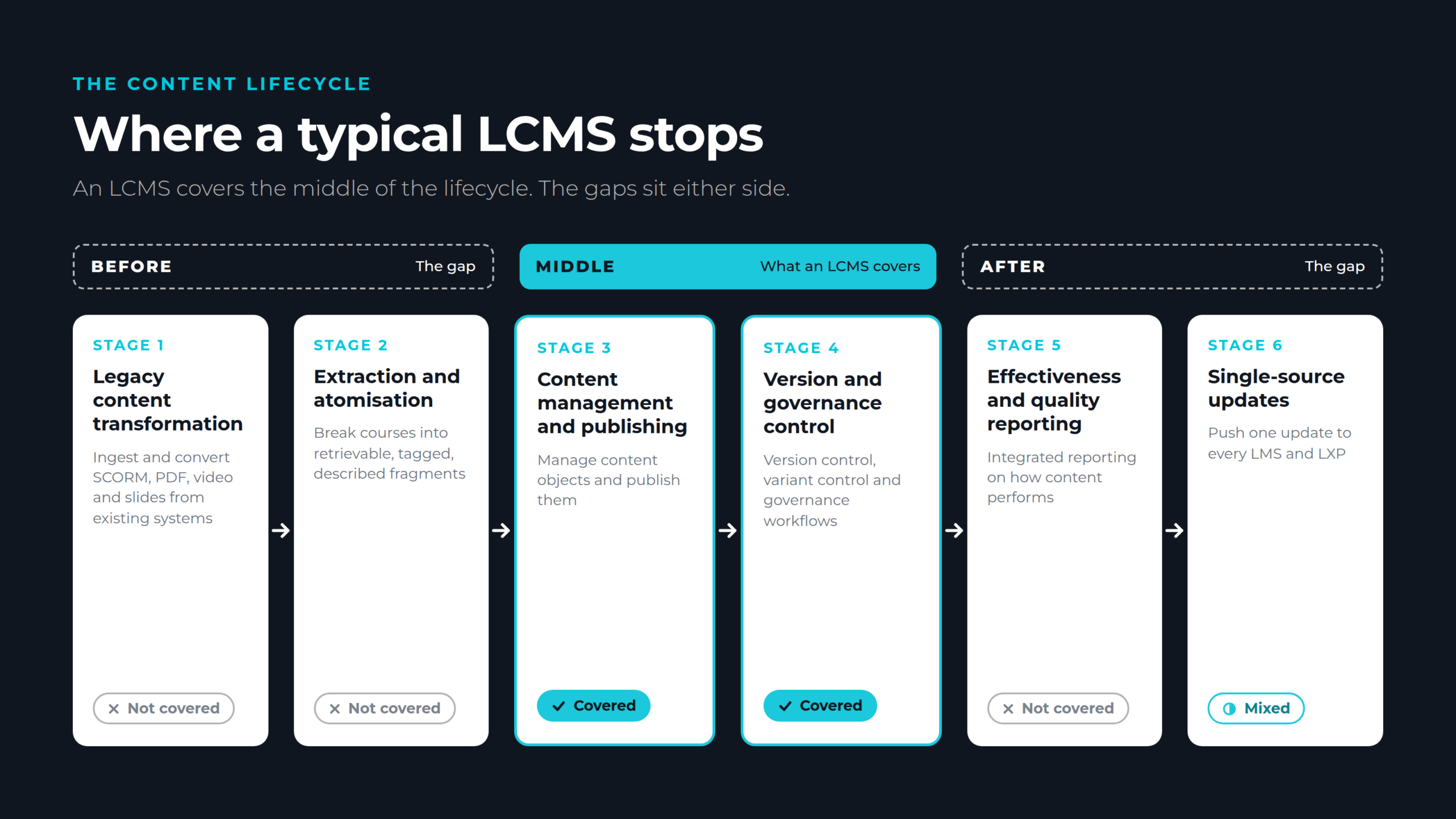
But the new goals that enterprises are bringing to this category now push well beyond what an LCMS has traditionally provided. An LCMS is good at managing content objects once they exist and controlling their versions. It is considerably less capable at everything that has to happen before and after that core function, especially in a world where AI agents are the primary delivery surface.
The reporting questions that matter for AI-delivered learning go far beyond ‘did the employee access it?’ It’s now possible to know, via agentic contextualisation and embedded intelligence, things like: what specific part did they use? Did they understand it? Can they apply it to a situation? Where are the remaining knowledge or skill gaps? What should they receive next?
No LCMS answers these questions because no LCMS was designed for a world where content is retrieved by agents rather than browsed by people. The capabilities that LCMS products handle well sit in the middle of the lifecycle. On either side, where the hard work of preparation and the hard work of governed delivery to AI systems need to happen, there is a gap.
We could call this the lifecycle content governance gap: the set of capabilities missing before content enters the management layer (extraction, atomisation, enrichment) and after it leaves (quality-scored retrieval, integration with AI agents via MCP, reporting, single source updates). Without closing this gap, the LCMS manages content that was never properly prepared and delivers it through channels it was never designed to serve.
Closing the gap: our most ambitious release
We have spent the past quarter building a release that closes this gap across the full content lifecycle. In terms of the range of functionality, it is the largest and most ambitious release in Filtered’s history. Here’s a brief tour, organised by the problems we’re addressing:
The content is locked in formats AI cannot read
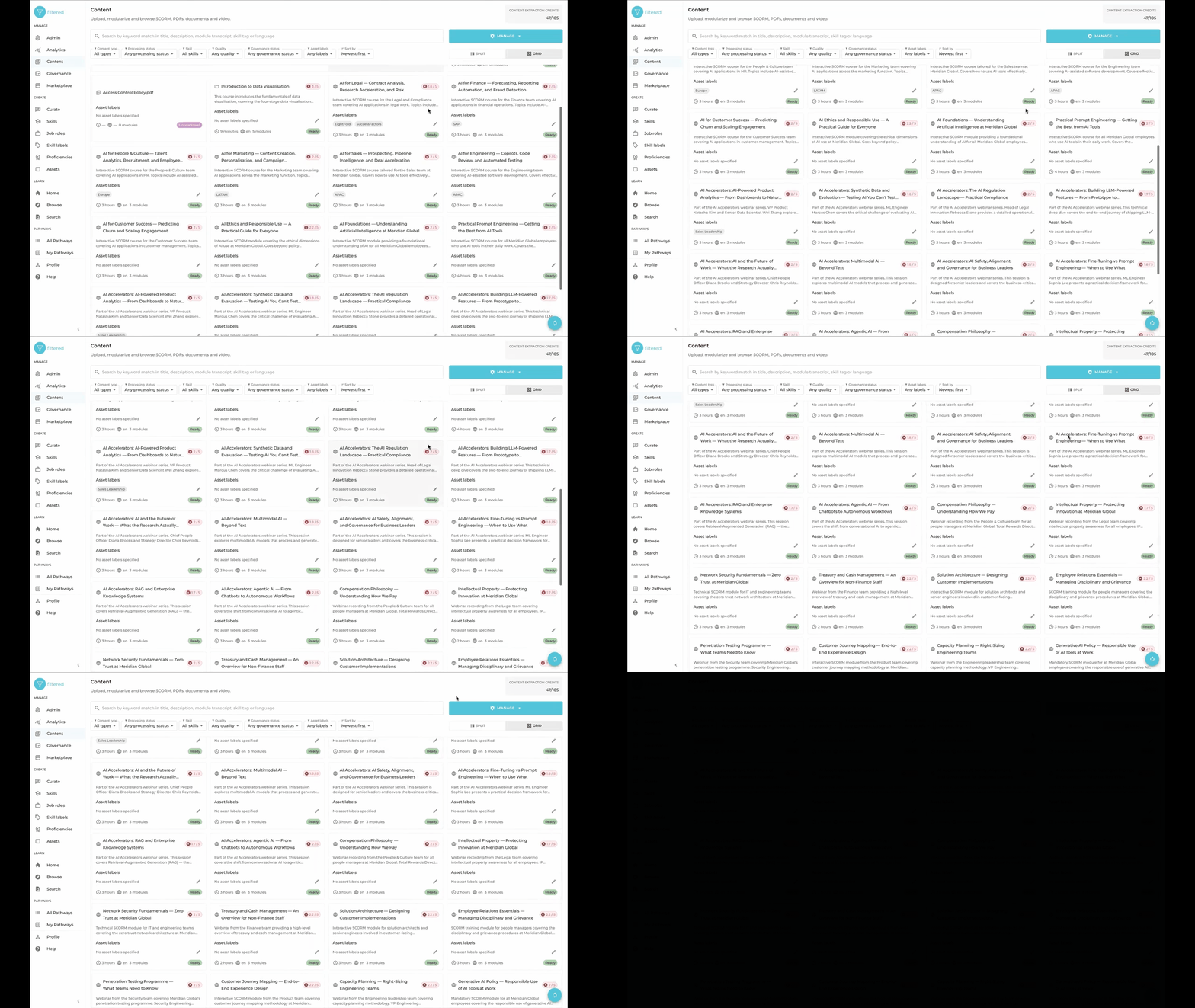
Most enterprise learning content sits in formats that are opaque to AI agents. SCORM packages are ZIP archives containing HTML, JavaScript and media in structures that vary by authoring tool. AICC content uses its own protocol. xAPI statements are machine-readable but tell you what happened, not what the content contains. PDFs, slide decks, video, audio: none of these are transparent to an agent trying to retrieve the right fragment for a specific question. And many LMS vendors make it remarkably difficult to export this content in the first place. The extraction pipeline we have built reads whatever format you have, generates structured transcripts and descriptions, and prepares each asset for atomisation. Our customer data consistently show that 50% or more of internal content items lack even a usable description. When a Big Four firm brought us 4,279 SCORM packages, the tagging output increased 7.4x after extraction, and the share of assets with usable skill coverage went from 16% to 46%. Extraction and enrichment is where the lifecycle governance process begins, because until this is done, agents are working blind.
We must be able to recompose learning objects from the extracted parts.
An AI agent does not serve a 45-minute compliance course. It serves as a two-minute answer to a specific question, drawn from one section of that course, tagged to a skill the employee is working on right now. For this to work, the fragments have to exist as discrete, described, governed objects. However, at the point at which learning is decomposed and can no longer be reconstructed, we lose control. Filtered now lets you reorganise extracted content into new learning objects: shorter modules, curated collections, pathways built from parts of different source assets. The goal is to restructure what already exists so it is findable at the granularity agents need, rather than generating new content with AI. As some customers have observed, these new structures of verified, validated, quality-scored content represent the ideal design for skill files to configure AI agents.
We need to be able to govern exactly what learning content agents can see.
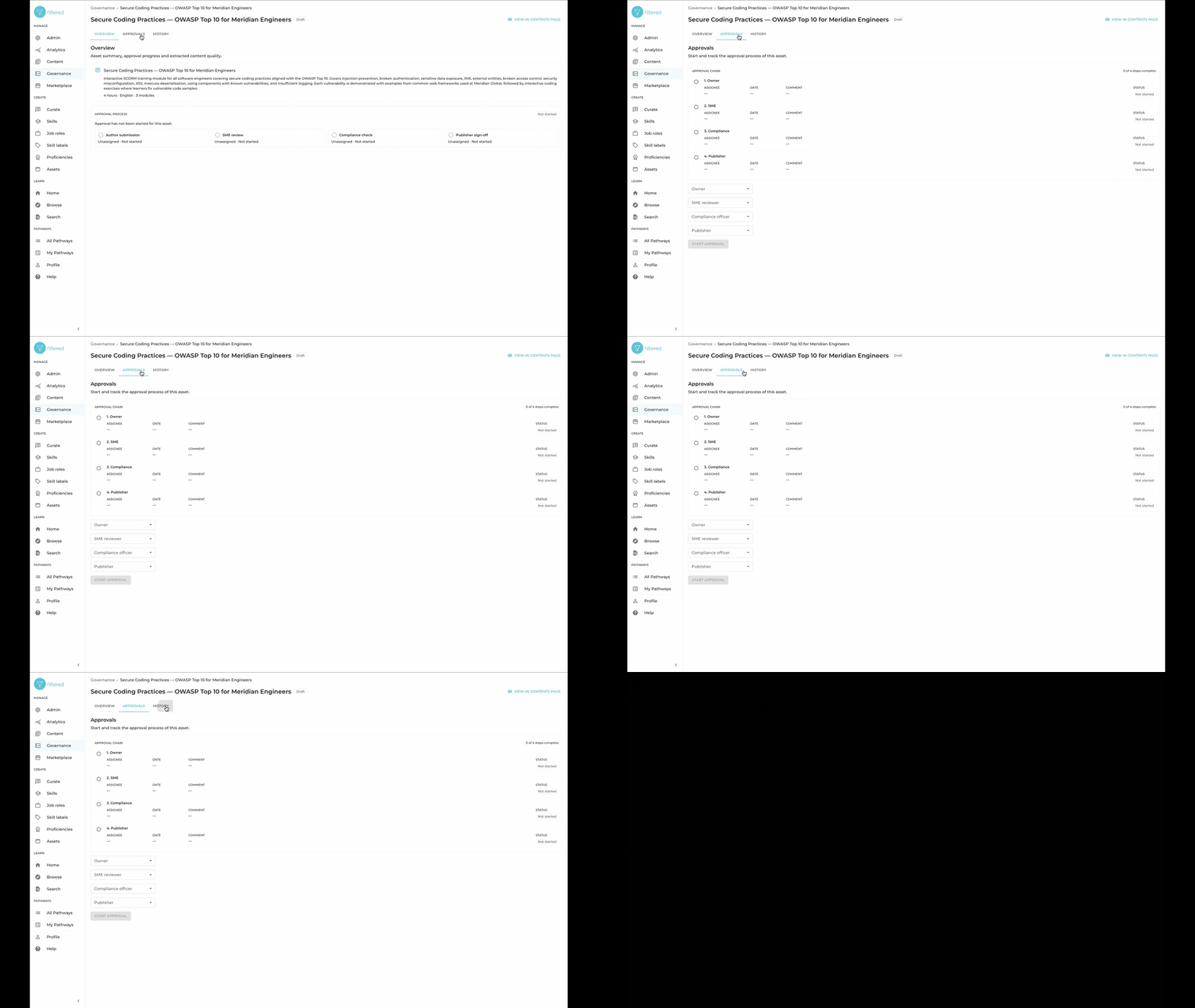
Content that has not been reviewed, approved and assigned an owner should not be accessible to AI agents. Every enterprise learning leader we speak to agrees with this in principle. In practice, most have no mechanism to enforce it. Filtered’s governance layer puts configurable approval workflows around every upload and every new object. Subject-matter experts review and approve content before it becomes agent-searchable. Localisation workflows handle variant control across languages and regions. In regulated industries this is a compliance requirement. Post-publication, administrators have granular control over the entire content base. Using adaptable filters, any set of content can instantly be endorsed or retired, and new labels can be added. As Lori Niles-Hofmann has written, getting the governance layer right is not a technical nice-to-have; it is the precondition for AI-powered learning that anyone will rely on.
The delivery surface demands governed content.
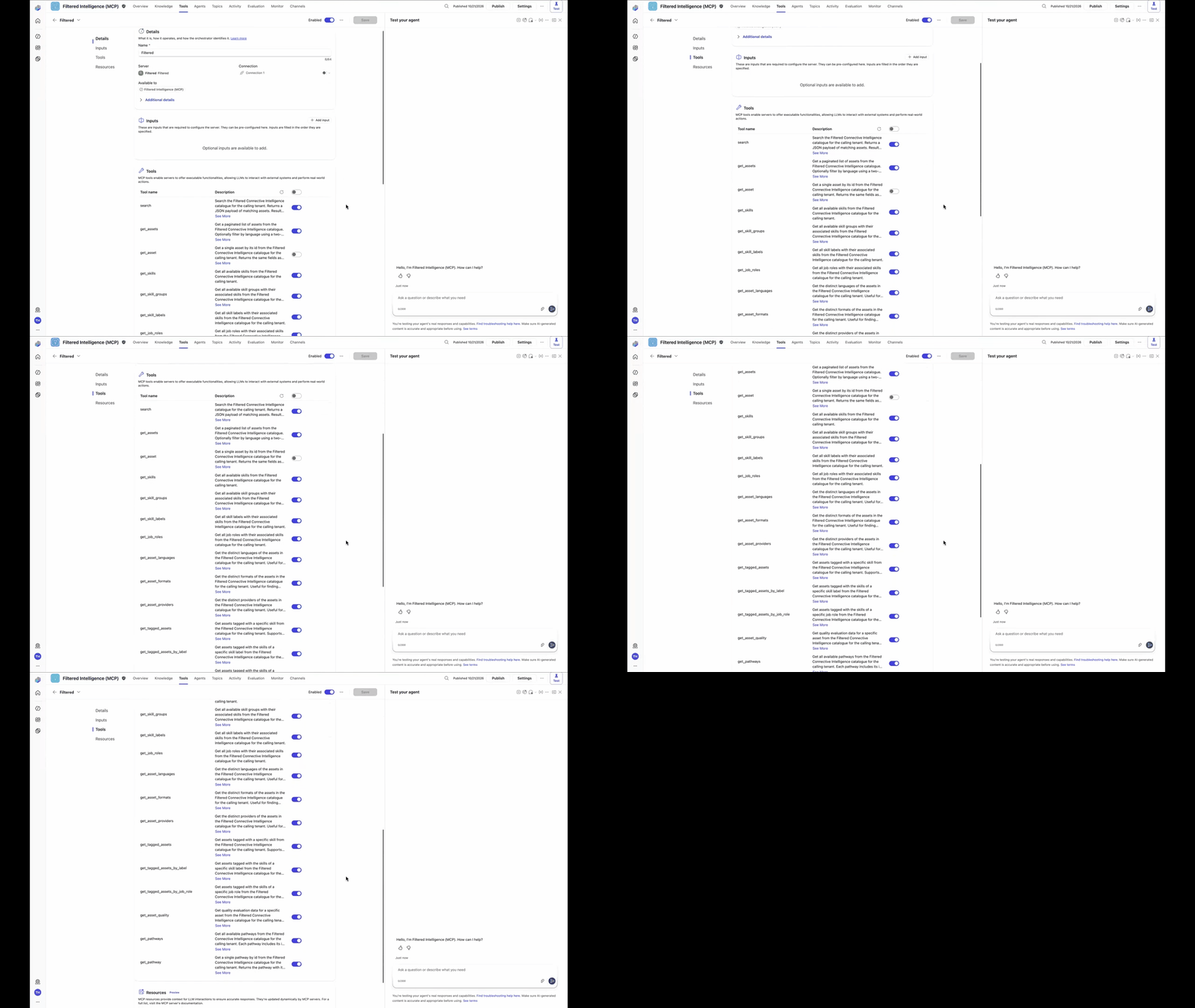
Governed, quality-scored content is exposed to AI agents through MCP (Model Context Protocol), the open standard that lets agents find and use external data. Copilot, Teams, Claude, ChatGPT Enterprise: any tool that speaks MCP draws on the governed knowledge base from day one, without a custom integration. This is what the prompt bar demands: content that has been through the full lifecycle of extraction, atomisation, tagging, scoring, governance and publishing. An MCP server over ungoverned content just automates the delivery of bad data. As we wrote in our last article, that is the definition of AI slop.
Built on the Filtered trust stack
These lifecycle governance capabilities extend the core Filtered Intelligence infrastructure our customers already use: skills tagging via Skills Framework Manager, content atomisation and quality scoring via SCORM Intelligence, and agent delivery via Connect AI, which includes our forthcoming Microsoft Copilot Marketplace Connector. The result is a step change: from a layer that enriches content to one that governs the full content lifecycle from source to agent.
None of this works if the infrastructure itself is not trusted, and trust is where many AI-enabled vendors fall down. Filtered runs all AI inference on self-hosted models via AWS Bedrock. No customer content is sent to a third-party inference provider. No customer data is used to train any model. Every scored asset is traceable: the reasoning behind each quality score and skill tag is visible, so the layer can show its working.
We have held ISO 27001 certification continuously since 2018 (currently ISO/IEC 27001:2022, UKAS-accredited, with zero nonconformities at our most recent audit) alongside Cyber Essentials certification. Our August 2026 penetration test returned zero critical and zero high findings, and the MCP server specifically had zero findings of any severity. Filtered is approved on the UK Government’s G-Cloud framework, central government is among our customers, and we are a certified Future Plus Impact organisation. For organisations handling sensitive content and people data, the trust stack underneath the AI is as important as the AI itself, and we have built accordingly.
What we are not claiming to solve
We are not pretending to solve the problem of designing organisations around AI. That second challenge (restructuring decision-making cadences, approval hierarchies and team workflows for AI-speed throughput) is real and difficult, and the people best placed to address it are the senior leaders inside those organisations, many of whom are our customers. The best ideas we hear about organisational redesign come from them, not from us.
What we can do is close the lifecycle content governance gap so that the shift from portal to AI agents does not leave your organisational knowledge behind. The surface of learning has changed. The competitive advantage belongs to the organisations whose proprietary knowledge is structured, governed and accessible to agents, because the knowledge base is the asset and the model is interchangeable.
The alternative is AI tools that serve confident answers from broken foundations: the mass production of AI slop, at scale, with your brand on it.
If you are ready to close the gap, starting with a demo and test on a batch of 1,000 SCORM packages for a meaningful test with budget you can easily find before the end of the year, talk to us.
1. My problem with the five moments is that they a) assume learners are motivated to work through the first four, and b) tack on ‘dealing with change’, as if change can be delivered by learning programmes alone. We tend to be highly motivated, efficient learners when something matters to us, and completely useless learners when it does not (see Tough: a better-researched framework than Mosher and Gottfredson’s). A framework based around the five moments for a new system, without the deep change management work to tie that system to employee needs, pains and desires, will not land. Change is an organisational design problem, and attitude is not a capability problem. Work like AssembleYou’s AI Confidence Method addresses precisely this: attitudes first, then capability. Will-do before can-do. Unless your machinery is wired along the desire lines that make people tick (ambition, pride, curiosity, desire), it will not work, no matter how neat it is.
YOUR ENTERPRISE AI PROGRAMME NEEDS THIS INFRASTRUCTURE
See how Filtered Intelligence connects your content, skills data and learning systems in a walkthrough built around your stack.